@henryqw/pi-footer


Keep footer identity, model usage, agent-work time, and extension status visible while you work in Pi. Use /open to open the current working directory. /open uses VS Code by default, or another configured command. You can enable the footer and the open commands independently.
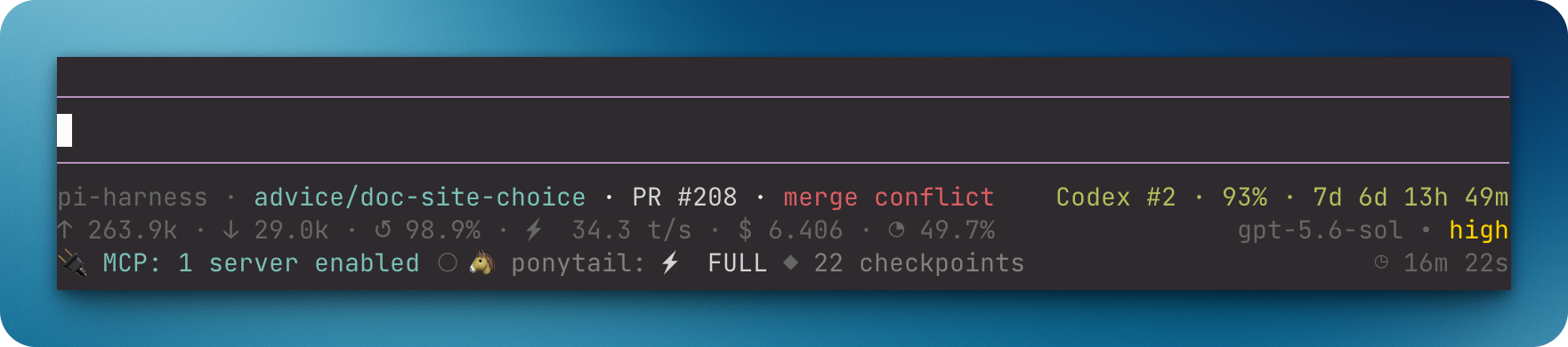
Install
pi install npm:@henryqw/pi-footerThis package requires Pi 1.1.0 or later in the 1.x series.
Version 3 replaces @henryqw/pi-open-in. If it is installed, remove it before you upgrade. This prevents duplicate /open and /set-open-in commands:
pi remove npm:@henryqw/pi-open-in
pi install npm:@henryqw/pi-footer
For project-local installs, use --local on both commands. Also remove manually configured paths to the old package. Then restart Pi. The existing open-command config stays at config/pi-open-in/config.json. Do not move it.
Both entry points load by default. To use /open without the custom footer, use Pi’s native package resource filter in settings.json:
{
  "packages": [
    {
      "source": "npm:@henryqw/pi-footer",
      "extensions": ["extensions/open.ts"]
    }
  ]
}
To use only the footer, select extensions/footer.ts instead. You can also use pi config to toggle either resource. You do not need package activation config.
Works with
| Package | Relationship | Purpose |
|---|---|---|
@henryqw/pi-codegraph |
Improves | Shows CodeGraph index status, quiet setup progress, and direct tool activity when loaded. |
@henryqw/pi-config-store |
Required | Owns config-home resolution and storage. |
@henryqw/pi-multi-codex |
Improves | Adds active Codex subscription quota and reset status. |
@henryqw/pi-pr |
Improves | Adds current-branch pull-request status. |
Use
After installation, start a Pi TUI session. The footer shows checkout, usage, model, thinking, and extension statuses. Run /open to open the current working directory in VS Code by default. /open also works while the agent is busy.
| Surface | Type | Purpose |
|---|---|---|
| Footer | ui | Shows footer identity, usage, model, agent-work time, and extension statuses. |
/open |
command | Opens the current working directory with the configured command. |
/set-open-in <command> |
command | Sets the command used by /open. |
Run /set-open-in <command> to choose another command, such as cursor --reuse-window. /open runs <command> <current-working-directory>.
pi-harness · clear-field-f8d2 [+2 ~3 ?1 ↑2] · PR #123 · approved    Codex #1 · 50% · 7d 1d 1h 22m
↑ 12.4k · ↓ 2.1k · ↺ 84.3% · ⚡ 87.4 t/s · $ 0.127 · ◔ 36.8%    gpt-5.6-luna • high
✓ CG · ● 🐴 ponytail: ⚡ FULL ◷ 12m 34s- The first line shows the repository, branch, Git state, and
pi-prpull request status beside the footer identity. Thepi-multi-codexquota status, when non-empty, occupies the right side. Linked-worktree branches drop the generatedworktree/prefix. - The second line shows cumulative input tokens, output tokens, latest cache-hit rate, and tokens per second for the most recent assistant response. The rate is timed from the first streamed content of the response to the last. Thus, the rate excludes request latency, time to first token, and provider work after the stream ends (such as the Claude bridge shutdown of Claude Code). A response that arrives without streamed content, or all at once, shows
—. It also shows estimated cost and context usage. Totals include reported tool usage and finishedpi-subagentbackground workflows. The active model and thinking level are right-aligned. Under a virtual model, the physical model and thinking level of the latest successful response follow an arrow, for exampleauto • high → gpt-5.6-luna • medium. This matches Pi’s built-in footer. - The third line shows CodeGraph’s icon and
CGfirst:✓ CGwhen indexed,○ CGwhen a Git repository has no index, or a dim spinner and elapsed time such as⠋ CG · indexing 8sduring setup. Non-Git directories show no index badge. Other extension statuses follow, such as⠋ deps · installing 12s. Dependency preparation statuses disappear when work completes. Persistent CodeGraph failures keep their theme-colored!icon and meaningful text. During directcodegraph_explorecalls,● CGtemporarily replaces the CodeGraph status. The status returns when the call finishes. A middle dot separates statuses. Cumulative agent-work time stays on the right, below the active model.
Git badges appear only when action is needed:
| Badge | Meaning |
|---|---|
+2 |
Two staged paths |
~3 |
Three unstaged tracked paths |
?N |
N untracked porcelain status entries |
!1 |
One unresolved path |
↑2 |
Two commits ahead of the upstream branch |
↓1 |
One commit behind the upstream branch |
?N counts porcelain status entries. In --untracked-files=normal mode, Git can collapse a whole untracked directory to one entry.
Active operations appear first, such as REBASE 3/7, MERGING, or CHERRY-PICKING. Detached HEAD uses the short commit form @a1b2c3d.
The extension reads local Git data with git status --porcelain=v2 --branch --untracked-files=normal. It refreshes after each agent run and branch change. It does not make an LLM call or fetch a remote. Ahead and behind counts use the last fetched upstream state.
Unavailable values render as — without a misleading percent sign.
off uses the same dim grey as the model name. Active levels use an ANSI-256 gradient: green minimal, yellow-green low, lime medium, yellow high, orange xhigh, and red max.
ultra renders as a rainbow when the active Pi runtime supplies that thinking level. Unsupported levels never appear.
Only the non-empty pi-multi-codex quota status occupies the right side of the first line. The pi-pr pull-request status stays beside footer identity, and CodeGraph index status, setup progress, or tool activity appears separately on the third line.
Statuses from other extensions, including Ponytail and pi-rewind, share the left side of the third line. They are sorted by key. Colors, links, glyphs, and interior spacing are preserved. Leading and trailing whitespace is trimmed, line breaks become spaces, and long statuses can be clipped to fit the footer. Only direct codegraph_explore tool calls trigger the ● CG badge. The footer does not show CodeGraph queries from inside scripted tools.
Config
Package-owned: ~/.pi/agent/config/pi-footer/config.json for footer colors and ~/.pi/agent/config/pi-open-in/config.json for the open command (both under getAgentDir() when overridden). The retained pi-open-in home belongs to the open commands now shipped here.
| Name | Description | Values | Default |
|---|---|---|---|
colors |
Colors for footer-owned text by role. | Object that maps color roles to theme tokens, #RGB, #RRGGBB, oklch(...), okhsl(...), or an ANSI index from 0 to 255. |
Built-in colors. |
command |
Command that /open runs. Required when the file exists. |
Non-empty string. | "code" |
The footer reads colors once per session start; run /reload after editing it. The file is never rewritten. A missing file or a missing role keeps the built-in color. At each session start, an invalid file shows a warning with the path and the reason, and the whole color config falls back to the built-in colors.
Footer color roles
Every role is optional:
| Role | Surface |
|---|---|
repository |
Repository name on the first line. |
branch |
Branch or checkout name, still hyperlink-wrapped when the terminal supports it. |
gitStatus |
Git badges such as [+2 ~3 ↑1]. |
input, output, cache, throughput, cost, context |
The six usage metrics on the second line. |
model |
Active model and routed physical model. |
runtime |
Cumulative agent-work time on the third line. |
codegraphActive |
The ● CG badge during a direct codegraph_explore call. |
separator |
Middle dots, bullets, arrows, and the truncation ellipsis. |
{
  "colors": {
    "repository": "muted",
    "branch": "accent",
    "gitStatus": "warning",
    "input": "#4ec9b0",
    "output": "#9cdcfe",
    "cache": "#c586c0",
    "throughput": "#dcdcaa",
    "cost": "#ce9178",
    "context": "#89d185",
    "model": "text",
    "runtime": "muted",
    "codegraphActive": "accent",
    "separator": "dim"
  }
}
Theme tokens are accent, dim, muted, text, success, warning, error, and thinkingText. Thinking levels keep their built-in gradient, and statuses from other extensions keep their producer colors; the colors object controls neither.
Open command
A missing file silently uses the default command, code. An invalid existing file makes /open fail visibly and stays unchanged. See Limits and recovery. /open reads the config on every run. Only /set-open-in writes the file, atomically. Reads do not create or write the config home.
API
Consumers: use the owner API. Do not read the config file directly. Replace imports from @henryqw/pi-open-in/open-uri with @henryqw/pi-footer/open-uri:
import { loadOpenInConfig } from "@henryqw/pi-footer/open-uri";

const { source, value } = loadOpenInConfig();
These exports are for package consumers. The commands in Use are the Pi interfaces.
| Surface | Type | Purpose |
|---|---|---|
default (openInExtension(pi)) |
function | Registers the open commands with Pi, without the footer. |
OpenInConfig |
type | Describes the configured command. |
loadOpenInConfig(agentDir?) |
function | Reads and validates the owner config. |
configuredOpenUri(path) |
function | Returns a safe VS Code URI for a supported command. |
loadOpenInConfig returns source as "missing" or "file". value.command is validated. Pass an agent directory when needed.
configuredOpenUri(path) works when the executable is code. With code -n or code --new-window, it adds windowId=_blank so the link opens in a new window. It returns undefined for other commands or invalid config. @henryqw/pi-config-store owns the config home and storage.
Limits and recovery
The open command splits on whitespace into an executable and arguments. Tokens cannot contain spaces, and quoting is unsupported. Use a wrapper script for executables in paths that contain spaces.
An existing config file must be a JSON object with exactly one non-empty string command property. Otherwise /open fails with a visible error, offers no open URI, and leaves the malformed file unchanged. If the configured command exits with an error, Pi reports its error output or exit code. Fix the command and run /open again.
When the configured executable is code and Pi reports hyperlink support, the accent-colored checkout name links to the current path. The link opens a new window for code -n or code --new-window. A missing config silently uses code. Other executables and terminals with hyperlinks disabled render plain text.
Pi handles the custom URI in its default fullscreen TUI. Use normal primary click. Regular TUI ("tuiMode": "regular" or --tui-mode regular) delegates OSC 8 activation to the terminal, so the link works only where the terminal opens custom URI schemes.
Ghostty uses Cmd+click, but it possibly does not open custom URI schemes.