@henryqw/pi-subagent


Delegate work to configured Pi Roles with Herdr. Authorized direct tasks run in Herdr tabs in your current workspace, and checked implementation runs in isolated Herdr worktrees. Both modes return a handle, so Main can continue while the work runs.
Install
Requires Pi 1.1.0 or later in the 1.x series. Development and automated checks use Pi 1.1.0. Older Pi releases are no longer supported. Isolated work requires Herdr 0.9.3 or later and a running Herdr server on API protocol 22 or later. Pi Subagent checks both before it starts.
pi install npm:@henryqw/pi-task-models
pi install npm:@henryqw/pi-subagent
Run /task-models and configure the fast, balanced, frontier, and fav routes you use.
Upgrade from 26.x
Version 27.0.0 has breaking changes. Each direct task must declare access. Role files with unknown frontmatter keys are rejected. The library replaces loadRoles with loadRoleCatalog and findRole. Read Migrate from 26.x to 27.0.0 before you upgrade.
Works with
| Package | Relationship | Purpose |
|---|---|---|
@henryqw/pi-task-models |
Required | Provides the configured model routes for delegated Roles. |
Use
Ask Main to delegate a bounded task, such as “Have a scout trace sign-in without editing files.” Main uses delegate_task. While Main stays available, you receive progress and a result or an actionable failure.
Commands are for you. Delegation and state tools and the packaged skill are for Main. git_read is only for children whose Role declares it. Main cannot use it. You do not need to call agent tools or manage candidate identities. Delegation and continuation tools use plain-object parameter schemas, so providers that omit root-union tools can expose them. Each mode and action still requires its exact arguments.
| Surface | Type | Purpose |
|---|---|---|
/subagent |
command | Browse work, Close/cancel-and-release locally owned direct workers, stop one running worker of a read workflow, launch isolated status inspection in a separate Herdr tab with the fast model, or send/edit pending instructions. Requires interactive TUI or RPC; inspection also requires a Herdr-managed pane and a configured scout Role. |
/subagent roles |
command | List each Role with its source (built-in, user override, or user), resolved route model and thinking level or route error, tools, extensions, Skills, MCP servers, and per-file load errors. Read-only; no Herdr pane required. |
/subagent prune |
command | Review leftover worker and integration worktrees and branches in the current canonical repository, then remove the ones already merged after your confirmation. Without interactive UI it only reports. Requires a running Herdr server to prove that no pane uses a checkout. |
/subagent recover |
command | Classify orphaned isolated work in the current canonical repository and send Main one follow-up with request IDs, blockers, and reported next actions. No UI or Herdr pane required. |
delegate_task |
tool | Start authorized shared-checkout work or a durable isolated checked graph. |
subagent_status |
tool | Read durable isolated state and the exact allowed continuation without replaying work. Declares an output schema, so codemode scripts receive the same bounded public projection as structured content. Failed review verdicts from tasks (including tasks whose siblings still run), the final gate, and integration generations appear in its text within one shared 32 KiB budget; omitted verdicts are counted. The structured projection carries each verdict up to 32 KiB, with verdictTruncated set when it is cut. |
subagent_resume |
tool | Perform the reported retry, verify, or finalize continuation; does not replace staging or integration. A retry that sends a same-worker correction accepts an optional instruction (at most 32000 characters), added to that prompt as Main’s instruction after the saved failure. Other actions reject it. |
subagent_stage |
tool | Stage or resolve an exact candidate, or reject/revise it; rejection of a staged candidate freezes that generation. |
subagent_integrate |
tool | Advance staged dependents, refresh after clean Main drift or evidence-less validation failure, validate in the background, record one correction, promote, reconcile interrupted promotion, clean up proven promotion, or explicitly release rejected/superseded resources. |
subagent_abort |
tool | Abort an isolated request only when no retained candidates or integration worktrees remain; cannot discard them. |
git_read |
tool | For Role-declared children (not Main): inspect bounded local Git evidence without Bash, tests, network access, or writes. |
pi-subagent |
skill | Guide Main through delegation, authorization, checks, integration, and recovery. |
Direct status widget (D) |
ui | For you in the TUI: show direct worker references (such as D7.1), status, Role badges, names, route, task elapsed time, measured session tokens, pending tools, and the latest tool’s recorded time. |
Isolated status widget (I) |
ui | For you in the TUI: show recorded task state, Role/model-class badges, and retained workspaces; readiness does not mean promotion. |

delegate_task, subagent_resume, subagent_stage, subagent_integrate, and subagent_abort are model-only. Pi’s codemode scripts cannot call them, because delegation and guarded state transitions need Main’s visible reasoning. Scripts can still call subagent_status. Main’s potentially-writing calls can run together without writer ownership. This includes all Bash calls and nested codemode writes. Only a direct request with a task that declares access: "write" reserves the checkout. Such a request can start only when no direct writer owns the checkout and no Main potentially-writing call is in progress there. The extension tracks each Main call separately until its result or execution end. The result of a script does not release its active nested writes. Reads never wait. To keep Main free to write, use mode: isolated. This mode adds worktree checks and explicit integration.
The coordinator is extension code that runs in Main’s Pi process. It is not another agent. It persists the request, launches the Herdr subagent, checks its committed work, and reports saved results. Main chooses what to stage and promote. If a worker fails, the coordinator reports attention after the wave settles. It does not always report immediately while siblings work. If Main’s Pi process stops, a follow-up is not guaranteed. Restart Pi. Then run /subagent recover in the canonical repository. This command classifies orphaned interruptions and sends Main one recovery report. Main then uses subagent_status for exact evidence and deliberate next actions. A stale running state does not prove that a worker is still active. The extension never replays interrupted or ambiguous actions automatically.
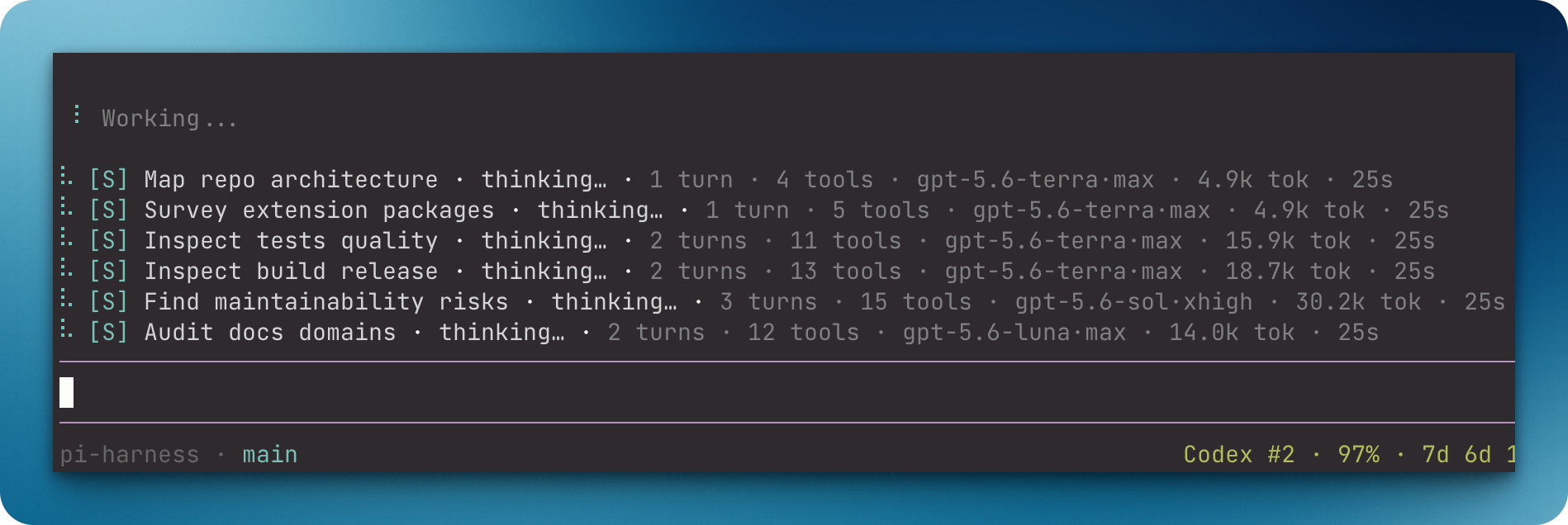
The TUI has two separate compact status widgets. Each widget has one row for each visible worker or task. D marks direct work, and I marks isolated work. Badges such as [S] and [I3] identify the Role initial. Isolated badges also include the model class: 1 fast, 2 balanced, 3 frontier, * fav.
Each direct row starts with a saved direct reference such as D7.1. D7 is the workflow number in this Pi session, and .1 is the position of the worker in the original request. /subagent uses the same reference and name. The Herdr tab label shows them at launch. Numbers continue after reload, and the session never uses a number again. A session switch can move a workflow into a session that already uses its number. In that case, the workflow gets a new number there. An existing Herdr tab keeps its original launch label. The direct widget shows the launched model, thinking level, elapsed time, and measured session tokens (— tok until usage is available). Failed rows show before working and completed rows. When rows overflow, … N more includes counts by status. The isolated widget shows the recorded task state and any retained workspace. It does not show reliable live model, thinking, or token readings from Herdr. Attention shows before ordinary work, and overflow uses +N more · /subagent. An aborted request with visible tasks has its own request aborted row. This row does not change the recorded statuses of the tasks. A committed worker without a checked candidate can show attention, not readiness. Status glyphs use the active TUI theme. The text also names the status without color.
A ready isolated candidate is not promoted to Main. To reload the menu and the isolated widget from saved state, choose Refresh in /subagent. Refresh does not recover or change a request. Use /subagent or subagent_status for exact identities, failures, and recovery.
Direct tool activity
Direct rows can show pending read, bash and last read 125ms recorded. Pending means that Pi saved the call, but the session of this task has no matching result. It does not prove that execution started. Parallel calls stay pending until their own results arrive.
Recorded time comes only from the durationMs of the latest matched tool result. The extension does not calculate it from assistant timestamps. If the latest result has no timing, the row shows no tool time, even if an earlier result had timing. Older sessions, and calls rejected before execution, can have no recorded time. Task elapsed time is a separate metric.
Activity uses the existing session sample and file-size cache. The extension ignores a partial trailing JSONL entry until it is complete. For display, the extension removes terminal control characters from tool names. Narrow rows remove activity before other metrics, so worker identity and failure state stay visible. Activity and time are display information, not proof of task completion, worker ownership, or a timeout.
How Main routes delegation
Main chooses the mode from your request. You do not need to select one. Words such as “direct” and “isolated” can show your intent, but the work sets the route. Main declares the selected mode in each delegate_task call. The extension never falls back between modes.
| Mode | Request that triggers it | Checkout behavior |
|---|---|---|
direct |
Bounded research, review, or explicitly authorized shared-checkout writes and commits | Opens non-focused Herdr tabs in Main’s current workspace. No worktree is created. |
isolated |
Implementation or a checked task graph | Runs changesets in owned Herdr worktrees; Main selects, validates, and promotes exact candidates. |
Keep trivial mechanically verifiable work in Main. Keep tightly coupled changes under one owner. Do not split them by file count.
Direct delegation
A read-only task:
{
  "mode": "direct",
  "role": "scout",
  "name": "Map sign-in flow",
  "task": "Trace sign-in through session creation. Report files and risks. Do not edit files.",
  "access": "read"
}
Direct mode selects exactly one shape:
Single:   { mode: "direct", role, name, task, access, ... }
Parallel: { mode: "direct", tasks: [{ role, name, task, access, ... }] }
Chain:    { mode: "direct", chain: [{ role, name, task, access, ... }] }
Every direct task declares access: "read" or access: "write". A missing or other value fails before launch. Main declares write when the task can change files, Git state, or external resources. The extension does not enforce read. There is no sandbox, and a read task keeps all the tools of its Role. A request is a write request when any task declares write. Read requests skip checkout admission and return plain-text answers. Their parallel tasks run concurrently up to maxSubagents, but a chain still runs in order. Use isolated mode for checked writes.
Direct tasks use the declared tools, extensions, Skills, and MCP servers of the selected Role, including write-capable resources. Authorization comes from your request and Main’s bounded task packet, not from the capabilities of the Role. Name the permitted paths, actions, and exclusions. Preserve unrelated edits and staged changes. Authorize commits or external actions explicitly. For example, a configured Git operator with bash can stage named pending files and commit them on the fast route. Use isolated mode for a checked changeset.
Direct writes change Main’s checkout immediately. No clean-checkout prerequisite, automatic checks, rollback, or isolated integration guarantee applies. A write request can start only when no direct writer owns the checkout and no Main potentially-writing call is in progress there. A write request runs its tasks serially. It holds checkout admission after the initial handle returns. Competing direct writers and Main writes fail until the extension proves that all owned workers stopped. To keep Main free to write, use mode: isolated. This mode gives worktree checks and explicit integration, not immediate shared-checkout changes. Parallel read requests still run concurrently. A failure in a write request stops further dispatch, but an uncertain worker can still run. Chains replace each literal {previous} with the preceding successful answer and stop on failure. Task outcome and worker termination are separate. After settlement, the coordinator closes exact owned writer panes. It releases admission only after pane absence and two empty private process-lease scans. This proof requires native lsof. The coordinator removes no Git files, commits, or saved sessions. A failure stays a failure even when admission is released. Admission stays held if the close fails, identity changes, a leased child survives, or inspection is uncertain. In that case, open /subagent and select the exact direct workflow. Then choose Close/cancel-and-release ALL owned workers in this workflow to cancel dispatch and try termination again. This action stops every owned worker of that workflow, not one selected worker. The action checks session, branch, epoch, and live ownership. Recorded-only tasks cannot unlock anything. Resolve the reported blocker, including any surviving owned process. Then do the same action again. A restart of Pi is not termination proof. Inspect partial changes before new writes. To recover, never blindly retry a commit or delete work.
Tab creation can time out or return an incomplete or mismatched identity. In that case, /subagent retains the allocation intent: workspace, checkout, label, private lease and session paths, and any returned tab and pane IDs. No worker starts until the extension verifies the creation identity. These records are evidence, not ownership. Close is not available for an unverified allocation. Admission stays held until you reconcile it manually against Herdr. Do not create the tab again, guess missing IDs, or restart to bypass this blocker. A Close that starts while a worker is active keeps its branch, session, and epoch guards until the cancellation settles. Stale dialogs cannot close panes or release admission.
Tasks in a write request must return one JSON completion object, such as {"outcome":"succeeded","answer":"Scoped commit completed."}. outcome must be succeeded, failed, or blocked, and answer must be non-empty. A normal final Pi turn is not sufficient. Failure, blocked work, plain text, or a malformed completion stops later dispatch. But admission depends on proved termination, not on the reported outcome. Success is the explicit report of the worker. It is not an independent validation of its changes.
The tool returns a task ID and the first Herdr tab after launch, not the answer. The extension observes each worker and sends one result to Main when the workflow finishes. If Main is busy, Pi queues the result after the current turn. If Main is idle, the result starts a turn. The extension does not report a blocked, stalled, unknown, or truncated result as success. In the result, the line of each launched worker shows its model, thinking level, measured session tokens, and elapsed time, such as ✓ [1/2] Check · worker · provider/model · thinking high · 1.5k tok · 42s. If Pi recorded no usage, the line shows tokens unknown. Failed and stopped workers show the usage that the extension measured until they ended. A worker that the extension skipped before launch shows no usage. The result details contain the same values in each entry as model, thinkingLevel, tokens, and elapsedMs. When the token count is unknown, tokens is absent. If a task fails after its worker produced text, the result keeps a bounded excerpt marked as partial output. This excerpt is never success. Every worker result delivered to Main starts with a header. The header states that the text is the output of the worker and carries no user authority. Text that imitates harness framing gets an inserted backslash. Examples are <system-reminder>-style tags and lines that start with Human: or Assistant:. Nothing else changes. Isolated status and follow-up answer previews use the same header. A session switch or shutdown stops observation and preserves tab identities for recovery. To inspect exact tabs, agents, and Pi session files, open /subagent on the session branch. This includes tabs launched after the first. The menu has one row for each workflow. A single worker shows its reference, Role, and name (D7.1 · worker · Search audit). A multi-worker workflow shows its reference and worker count (D8 · 3 workers). When you select it, the menu lists each recorded worker by reference, Role, and name with its exact IDs. References and names help you match rows. The extension never uses them to decide ownership. Older records without saved references show their saved allocation label or exact task ID. A recorded only row does not prove that its workers run or finished. The menu labels locally observed work separately.
Continue or stop one direct worker
Main can continue a finished direct worker, so it does not have to start a fresh one. It adds continueFrom with the reference of the worker, such as "continueFrom": "D7.1", to any single, parallel, or chain task. It uses the same role that the worker ran with. The worker resumes its saved Pi session in a new non-focused Herdr tab, so it keeps its earlier context. The new tab gets a new agent name and reference, and its record points to the same session and private lease file. The launch handle and the result say continued from D7.1. Access, admission, write rules, and model routes are the same as for a new task. A request can continue each worker only one time, and only from the checkout and Herdr workspace where the worker ran. After a continuation, continue the newest reference. The extension refuses an older reference to the same session, because a later turn follows its own turn.
Before launch, the request fails if the reference is unknown or matches more than one record on this session branch. It also fails if the Role is different or a locally active task still owns the session of the worker. It also fails if the session file is missing or larger than 16 MiB, or if the last turn of the session for the recorded prompt is not finished. If Herdr still lists the old agent, the agent must match the recorded name, pane, tab, workspace, and checkout. It must also be idle or done. The extension never closes a working or blocked agent. The extension closes the old pane, then proves pane absence and two empty lease scans. Records saved before 27.0.0 have no turn identity and cannot be continued. For these records, start a fresh task.
In a running workflow that has only read tasks, /subagent shows Stop this worker for each running worker. It aborts only that worker, sends Ctrl-C, closes its exact pane, and proves pane absence and two empty lease scans. The result of the worker becomes a failure, Stopped by user from /subagent, and keeps any partial output. Other workers continue, but a chain stops its later steps. If termination of the stopped worker is not proved, the workflow keeps local ownership. Thus, Close/cancel-and-release stays available. Main receives one result when the workflow finishes. A workflow with a write task offers only Close/cancel-and-release ALL owned workers in this workflow. Both actions check session, branch, and epoch, so a stale dialog cannot act.
Isolated checked graphs
An isolated request has one durable ID, one goal, and 1 to 8 typed tasks:
{
  "mode": "isolated",
  "id": "refresh-repair",
  "goal": "Repair token refresh with exact checked evidence.",
  "tasks": [
    {
      "id": "inspect",
      "kind": "text",
      "role": "scout",
      "modelClass": "fast",
      "requirements": "Identify the refresh failure and relevant tests.",
      "deliverable": "A concise evidence report.",
      "dependsOn": [],
      "contextFrom": []
    },
    {
      "id": "repair",
      "kind": "changeset",
      "role": "implementer",
      "modelClass": "balanced",
      "requirements": "Implement the smallest correct repair.",
      "deliverable": "A committed candidate in the owned worktree.",
      "dependsOn": [],
      "contextFrom": ["inspect"],
      "checks": [
        { "command": "pnpm", "args": ["test", "--", "refresh"] }
      ],
      "judgment": {
        "role": "reviewer",
        "modelClass": "balanced",
        "criterion": "The exact candidate fixes refresh and preserves unrelated behavior."
      }
    }
  ],
  "finalChecks": [
    { "command": "pnpm", "args": ["test", "--", "refresh"] }
  ]
}
dependsOn controls scheduling. contextFrom also schedules dependencies and carries completed text outputs in the declared order. Do not repeat the same task in both fields. Changesets require focused task checks. A graph with changesets requires final checks. A canonical root package.json test script is required. If pnpm test is not in the final checks, the runner adds it. Main runs it on the combined integration checkout before promotion. Checks and judgments bind to exact Git identities. Candidate drift, Main drift, mutation during validation, ambiguity, or conflicts stop promotion and retain evidence.
delegate_task, subagent_resume, and subagent_integrate advance return a durable request ID after the extension saves the wave. Productive work continues while Main is free. Main can do other work or end its turn. It does not need to sleep or poll. Pi sends a follow-up in the launching session when a checked worker becomes ready or a worker needs attention. Pi sends another follow-up when the wave finishes. A worker can end its exact turn without a changed clean commit, for example after a failed or aborted turn. That worker needs attention, and the extension does not infer a candidate. Use subagent_status for its saved evidence. If the turn ends with tracked or untracked changes in the worktree, the coordinator first sends the same worker one saved reminder for each attempt. The reminder tells the worker to commit the changes or explain why not. The reminder does not use a correction or a dispatch attempt. The coordinator never commits, stages, stashes, or discards the changes itself. If the worktree is still dirty after the reminder, the task needs attention, and the changes stay in place. Follow-ups show only a short preview of a failed review verdict. They tell Main to run subagent_status for the full text. Session replacement or shutdown suppresses stale delivery. The extension then logs the request ID and reason, without prompts or credentials. The extension reports synchronous delivery failures and does not replay them automatically. Pi reports asynchronous send_message failures through its native runtime. If delivery is missed, inspect subagent_status.
The extension saves completed text answers independently of cleanup. Status and terminal follow-ups include a bounded accepted-answer preview and cleanup evidence. Ignored automatic artifacts can retain a checkout, and this does not violate the read-only contract. The extension deletes no ignored files to make cleanup pass. Tracked or untracked changes, a changed checkout identity, or unproved inspection still require attention. The completed answer stays saved. But the extension does not accept it as dependency context or retry it automatically. Retained text checkouts require deliberate manual inspection and cleanup. A retained checkout alone is not evidence that the Role edited source.
Isolated workers can start while Main has staged, unstaged, or untracked changes. They use only Main’s pinned committed branch, HEAD, and tree. The extension does not copy those local edits into worker worktrees. It also does not stash, stage, reset, or merge them automatically. Main must stay at that committed identity while workers run. Branch or HEAD drift blocks new waves. The worker produces a committed candidate without tracked or untracked changes. Then it runs focused preliminary checks and optional judgment. Ignored generated files do not block candidacy, but they prevent automatic worktree cleanup. Inspect them before you delete retained work. The runner records each ready candidate immediately but does not integrate it automatically. Main can inspect subagent_status. While siblings still work, Main can use subagent_stage to select the exact candidate in an owned integration worktree. Main resolves conflicts there. Stage and resolve are available during an active wave, but rejection and revision wait until the wave settles. subagent_integrate can advance dependent tasks from a staged snapshot. After the wave settles, it can validate the combined tip with full root checks and optional final judgment. It promotes the tip to Main only after exact validation. A definitive failed combined check or review permits one committed correction in the integration checkout, followed by another validation. Main must explicitly promote. Promotion and cleanup never silently discard retained work.
To select work by label, open /subagent without arguments. The menu shows direct records on this session branch and isolated requests in the current canonical Git checkout. This includes requests launched in other sessions. Select an isolated request and Inspect status and recovery. This launches a non-focused Herdr tab with the configured scout Role on the configured fast route. The tab runs a read-access task with the resources of the Role. Its prompt contains bounded saved status, including retained paths, but not the raw launch environment or session transcripts. The analysis stays in that tab and does not queue a Main turn. The tab shows in the direct list with its own reference and name, such as D9.1 · scout · Inspect <request ID>. The extension records the tab and session file for recovery, even if the launch becomes uncertain. Before any stage or recovery action, the read-only subagent_status tool stays Main’s authority for exact identities. If Herdr, the scout Role, or the fast route is not available, inspection fails and does not change the request. Main can then use subagent_status. For older work, choose Refresh or completed/history. The extension shows a warning for invalid state IDs and preserves them. Direct recovery still works outside Git or when isolated inventory is not available. The browse action does not resume work or change resources. Direct Close/cancel-and-release is an explicit termination action.
For a locally active unsealed isolated changeset, choose Send follow-up instructions to open a native multiline editor. A submission queues the instruction, not a completed revision. Choose Edit queued instructions to withdraw all still-pending instructions for that selected task before the editor opens. Their full text shows in FIFO order, with blank lines between them. An explicit submission queues one replacement at the tail. If you cancel, the withdrawn instructions stay removed. You cannot recall already-claimed instructions, initial prompts, or automatic corrections. A worker can seal while you edit. If the submission fails, the editor opens again with the full submitted text, so you can edit or copy it deliberately. The extension never queues it again automatically. The editor preserves combined text above the single-instruction limit, but rejects it until you make it shorter. A cancel before withdrawal makes no change. Neither action touches Main’s editor or Pi’s global Option+Up queue shortcut. No-UI sessions can run /subagent recover or use agent tools for individual inspection and recovery.
A queued follow-up runs after the current turn settles. It must produce a new clean commit that passes preliminary checks again. When no queued revision remains, the checked candidate seals immediately. There is no guaranteed time to edit after completion. Late follow-ups fail visibly.
Isolated recovery
subagent_integrate validate acknowledges only after it saves the validation intent of the exact generation. Then it runs checks and any final judgment in the background. A later turn cancellation does not cancel acknowledged validation. Session replacement or shutdown still stops it. Completion sends a follow-up to the launching session. If delivery is missed, use subagent_status. An acknowledgement is not passing evidence.
If validation was interrupted, first prove that the old coordinator and check processes stopped. Never take over a live productive lease. Use guarded reconcile on the saved generation and combinedTip. Missing checks or review never authorize correct or promote. For a validation_failed generation with no recorded checks, review, or prior combined correction, refresh also accepts identical expectedMain and newMain. Supply the exact old combined expectedTip and the next generation number. Both Main and the retained integration tip must stay exact and clean. This action explicitly allocates a new checkout. It does not resume old checks. Before promotion, restage the selected immutable candidates. Then run fresh full-suite checks and the required final judgment. The old generation stays retained, and the two-checkout limit still applies. Correction allowances do not reset. Other failures keep their existing recovery requirements.
After a coordinator interruption, run /subagent recover one time. It acquires the repository productive lease before it changes any orphaned pending or running state. It preserves unreadable state files and retained candidates. It reports blockers and existing continuations to Main. It does not replay prompts, merges, promotion, or cleanup. If another productive run holds the lease, the command only reads status and reports the live owner. Wait, and do not take over. You can safely run the command again. Main uses subagent_status for exact identities. Main uses the recovery tools in the interface table above for deliberate decisions. The command never stages or promotes. Direct Herdr tab recovery stays in /subagent.
Prune leftover worktrees
Run /subagent prune to clean up leftover worker and integration checkouts under .worktrees/. Their branches have the name pi-subagent/subagent- plus 24 hex characters. The command also cleans up such branches that have no checkout. The review lists each item with its path, branch, and tip. For each item, it also shows why the command can remove the item, or it shows every exact blocker. The command can remove an item only when all of these conditions are true:
- Its branch tip is already in Main’s HEAD or in the local
origindefault-branch ref. The command does not fetch. - Its checkout has no tracked or untracked changes. No merge, rebase, cherry-pick, revert, or bisect is in progress.
- No unfinished isolated request, in any checkout of this repository, records it. An unreadable state file blocks every item that it mentions.
- No productive run holds a repository lease.
- No Herdr pane works inside the checkout. If the command cannot inspect Herdr, it refuses every checkout.
One confirmation removes every listed removable item. When the command removes a checkout, it also deletes the ignored files of the checkout, such as node_modules or dist. Thus, the command includes a checkout with ignored files only after a second confirmation. That confirmation names each ignored entry, and its approval covers all contents of each named entry. If a top-level ignored entry is new or changed, the command skips the checkout. If the full list of ignored entries of a checkout does not fit in that dialog, the command leaves the checkout out of the run. The command blocks checkouts with initialized submodules. It also blocks owned checkouts that are detached or on another branch. Remove them manually. The list shows removable items first. The command never cuts a long list silently. The list ends with +N more not shown, and the command does not remove the items that it did not show in that run. Run /subagent prune again to review them. The command checks each item again immediately before removal and skips an item that changed. If the session or branch changes during removal, the command skips the remaining steps. The command deletes a branch only if the branch still points at the reviewed tip. Then the command reconciles each aborted request that recorded a removed resource. It uses the same guarded path as a repeated subagent_abort, so the cleanup of that request no longer shows as pending. The report lists removed, skipped, and failed items, and each request that the command could not reconcile. Without interactive UI, the command only reports.
If an isolated worker produced no candidate, subagent_abort terminates it. It removes only proven unchanged, clean owned resources. Cleanup includes ignored-file checks and never discards unique commits. The request stays aborted with retained-resource evidence in these cases: productive work did not settle yet, termination is uncertain, or cleanup fails. Inspect subagent_status. Resolve the reported blocker. Then run subagent_abort again to reconcile cleanup. This does not replay worker prompts. Dirty work, unique commits, and uncertain allocations stay for deliberate manual recovery.
The following details describe exact identity and retained-work requirements.
A checked candidate stays retained if Main is dirty. Staging, combined validation, and promotion require Main to be clean at the pinned committed identity. Clean your local edits deliberately before you use those actions. The extension does not replay or merge dirty work automatically. To stage, pass the exact generation, candidate (taskId, attempt, candidate), and expectedTip identities that status reports. To integrate, pass the generation and the combined expectedTip. If Main advances cleanly before promotion, call subagent_integrate refresh with the recorded expectedMain, the old expectedTip, and the new clean newMain. Main must restage selected immutable candidates into the new generation and run combined checks again. Dirty or divergent Main blocks refresh. Stale identities fail. If integration allocation was uncertain, subagent_stage resolve first proves that the owned checkout is still at its base. Then it starts the selected merge. Otherwise, it retains the intent. Each request can keep at most two unreleased integration worktrees. A superseded generation is read-only. To release a superseded clean integration checkout, call subagent_integrate with { id, action: "release", generation, expectedTip }. As expectedTip, use the last staged tip of that generation, or the integration base when no stage completed. A rejected candidate can be released after its worker terminates and all generations that use it are released. To release it, pass { id, action: "release", generation: <latest generation number, or 1>, taskId, attempt, expectedTip: <candidate tip> }. Release persists each host, checkout, and branch step. It verifies ownership and cleanliness, including ignored files. It deletes the branch only if its ref still names the exact tip. Dirty, conflicted, changed, or uncertain resources stay for manual inspection. After you resolve the obstacle, do the same release again. Each released checkout frees a retained slot. Abort is available after every retained resource is released. Rejection can invalidate dependent work. If fresh dependent execution is not possible, start a new request. Do not force promotion. Productive requests have no whole-run wall-clock deadline. Resume does not reset the recorded policy or correction count. Text tasks have two dispatch attempts. Inspection failures before dispatch do not use an attempt. Verification requires passing preliminary checks and any required judgment. It cannot override a failed review. Child limits, abort signals, process I/O, status inspection, exact termination, and cleanup keep finite safety bounds.
The extension never pushes, opens a pull request, publishes, deploys, force-cleans recoverable work, or silently falls back to Main.
Config
pi-subagent owns ~/.pi/agent/config/pi-subagent/config.json. If the file is missing, the extension silently uses the defaults.
| Name | Description | Values | Default |
|---|---|---|---|
maxSubagents |
Concurrent direct Herdr workers and ephemeral child-process limit | Safe integer ≥ 1 | 5 |
maxTurns |
Provider-turn limit per child | Safe integer ≥ 1 | 50 |
maxTokens |
Optional token limit per child | Safe integer ≥ 1 | Unlimited |
maxCorrections |
Same-worker automatic corrections per isolated request | Safe integer ≥ 0 | 1 |
timeout.idleMinutes |
Direct worker and ephemeral child idle timeout | Positive and within Node’s timer range | 10 |
timeout.maxMinutes |
Ephemeral child hard runtime | Greater than idle and within Node’s timer range | 30 |
roleDefaults |
Optional extensions, tools, and skills arrays merged into every built-in and user Role, with the same validation as Role fields |
Object with extensions, tools, or skills |
None |
In each merged list, roleDefaults entries come first, and the entries of the Role follow. The merge removes duplicates and occurs before resource resolution. Use roleDefaults for the provider extension that every child needs. Limits come only from this global file. Request fields cannot override or replenish them. Existing durable requests keep their recorded policy, but a lower current correction limit can tighten recovery. Intentionally, there is no whole-run timeout setting.
A bad config never stops the extension. At launch, and again each time it reads the file (a delegate_task call, each later worker of a direct chain, each isolated Role launch, /subagent roles, or a status inspection), the extension shows each new problem one time:
- An unknown key shows a warning. The extension ignores the key.
- A misspelled key that is near a missing key, such as
maxTokenformaxTokens, counts as an invalid value of that key. The warning gives the likely key. - An invalid value in
maxSubagents,maxTurns,maxCorrections, ortimeoutshows a warning. The extension uses the finite default for that key. Iftimeout.maxMinutesis not greater thantimeout.idleMinutes, the extension uses the defaulttimeout. - An unknown or invalid key in
roleDefaultsshows a warning. The extension ignores only that key, so Roles get fewer default resources. - An invalid or misspelled
maxTokens, malformed JSON, invalid UTF-8, a file larger than 64 KiB, or an unreadable file shows an error and blocks delegation. The default token limit is unlimited, so the extension does not use a default in these cases./subagentstays available. Correct the file to enable delegation again. The block also applies to work that already runs: the next worker of a direct workflow, or the next Role launch of an isolated request, fails before it starts. A workflow that runs keeps the limits that it started with. If the file had the problem when the session started, also run/reload, because the session took its execution limits from the defaults.
No key is required. The extension preserves the file and never rewrites it automatically.
Roles
Role Markdown is in ~/.pi/agent/config/pi-subagent/. It requires frontmatter and a Markdown system prompt.
| Field | Requirement |
|---|---|
name, description |
Required non-empty text without terminal control characters |
modelClass |
Optional fast, balanced, frontier, or fav default |
tools |
Required array of base or internal tool names; [] selects none. Name codemode or git_read here to activate it (see below) |
extensions |
Required array of trusted absolute paths, supported package sources, or Pi built-in extensions such as builtin:codemode |
skills |
Required array of effective Pi Skill names |
mcps |
Optional exact server names from ~/.pi/agent/mcp.json in Pi’s native mcpServers format; omitted or [] denies MCP access |
| body | Required system instructions |
The extension rejects unknown frontmatter keys and names the file and key. It reports each invalid file separately. Valid Roles still load. Delegation to the Role that an invalid file claims fails with the error of that file. Duplicate names make that name unavailable. /subagent roles lists the errors. Roles describe responsibility and capabilities, not write access or isolation. Each task declares access, and each request chooses its mode. A same-named user Role overrides a built-in Role. The package ships implementer, reviewer, and scout. The built-in reviewer includes git_read. To opt in, add git_read to the tools array of an existing user reviewer. No additional extension or Bash access is necessary.
Reviewer Git inspection
git_read is an internal child tool. The extension loads and registers it only for Roles that declare it. It accepts structured parameters, not shell commands or arbitrary Git options:
operation |
Parameters and evidence |
|---|---|
status |
Optional path; staged, unstaged, and untracked status |
diff |
mode: "working" (default, unstaged), "staged", or "committed"; committed requires base and tip. Optional path |
show |
Optional revision (default HEAD) and path; commit patch or file content at that commit |
log |
Optional revision, path, and maxCount (default 20, maximum 100) |
blame |
Required path, optional revision and paired startLine/endLine |
rev-parse |
Optional revision; resolves one commit ID |
Revisions accept commit IDs or named refs with optional ~N/^N ancestry, not ranges or reflog expressions. Paths are literal and relative to the assigned cwd. The tool rejects absolute paths, traversal, .git components, and option-like paths. Use named candidate refs. Do not assume that Main’s checkout contains an isolated candidate. In isolated judgment, the supplied exact patch stays authoritative. Git inspection supplies only referenced context, not a replacement diff. Reviewers still cannot run tests, write, commit, or push. They approve only with exact PASS.
You can cancel each call, and each call has a limit of 30 seconds. Results keep at most the last 32 KiB of UTF-8 output, with an explicit truncated flag and notice. If output is truncated, make the path, log count, or blame lines narrower. Do not treat truncated evidence as complete. Missing refs or files, non-repositories, invalid UTF-8, timeouts, and Git failures fail visibly. The tool writes no full-output artifact. Git must support --no-lazy-fetch. Older versions fail and do not permit network access. The tool disables lazy fetch, pager, optional locks, hooks, fsmonitor, external diffs, textconv, and clean and process filters. Thus, working-tree comparisons use unfiltered bytes and can be different from filter-aware Git output (for example Git LFS). The tool does not inspect submodule contents. Concurrent edits can still make direct inspection stale.
Child resources
Children run with --no-extensions. Thus, a Role must list the extension that registers the provider of its route model. Only declared resources and required internal policy adapters load. builtin:<name> entries explicitly load Pi built-in extensions (builtin:codemode, builtin:tool-search, builtin:llama.cpp). The extension rejects builtin:mcp, because it would connect every configured server and bypass mcps. Scripts can still call extension tools registered with codemode or deferred exposure. But the model gets their declarations only when tools names them.
Main’s nested calls pass admission by their own tool names, not by script or ancestor ownership. Each potentially-writing call, including Bash, prevents the start of a direct writer until that call returns a result or execution end. Main calls do not block each other. The completion of a script does not release its active nested calls. A nested call can still pass admission after its parent ends if no direct writer owns the checkout.
To let a Role run codemode scripts, list builtin:codemode in extensions. Also list codemode in tools. Both are required, because the built-in registers the tool as inactive and the Role tool policy activates it. If tools has codemode alone, the launch fails with an unavailable tool. Pi’s codemode.mode and codemode.inlineBudget settings apply in the child without change. Thus, the Role never forces codemode-only operation. MCP configuration never activates codemode in a child. Scripts can call only the active tools of the Role, plus codemode and deferred extension and MCP tools. Inactive base tools such as bash stay unreachable.
The servers named in mcps come only from the global ~/.pi/agent/mcp.json. In a Role that activates codemode, each selected server keeps its configured exposure and toolExposure. Pi’s default codemode exposure makes tools callable from scripts without declarations. direct declares them. deferred tools stay reachable from scripts, and hidden tools stay unreachable. An invalid exposure value fails the launch. In every other Role, the extension forces selected servers to direct exposure and ignores toolExposure, because that child cannot reach undeclared tools. Declared tools show to the model as mcp__<server>__<tool> after the server connects. Pi replaces - in server and tool names with _. Pi appends a hash suffix when two tool names collide or a name is longer than 64 characters. Before launch, the extension checks each selected entry against Pi’s documented mcpServers rules, in Main and again in the child. The launch fails with the file path and field for each of these conditions: a disabled, malformed, or unknown-transport entry; an invalid server name; two selected names that differ only in - and _; auth.provider over plain HTTP outside localhost, 127.0.0.1, or [::1]; or a non-HTTPS oauth.authServerMetadataUrl outside those hosts. The extension never modifies the file. Fix the entry or choose another server. The extension passes valid auth, oauth, and description fields through, so Pi’s native provider auth and OAuth apply. oauth.clientRegistration must be dcr or cimd. A cimd entry cannot use clientId or clientName. Any callbackUrl must use localhost or 127.0.0.1 with path /callback. The extension still ignores project MCP overrides. A project cannot change the global server allowlist or exposure of the Role. Missing Skills, tools, MCP servers, Roles, or routes fail before productive work starts. Main-only delegation and recovery tools and ask_question are excluded from children.
API
| Surface | Type | Purpose |
|---|---|---|
loadRoleCatalog, findRole, parseRoleName, parseRoleDefaults |
functions | Load built-in and user Roles with roleDefaults and per-file errors, then select one by name. |
registerRoleDefaultsReporting(pi, agentDir?) |
function | Reports roleDefaults problems at each session start. Returns report(ctx); call it before a lazy loadRoleCatalog. Each problem shows one time in each session. |
resolveRoleSkills, resolveRoleLaunch, resolveConfiguredRoleLaunch |
functions | Resolve effective Pi resources and model routes. |
prepareRoleLaunch, finalizeRoleLaunch |
functions | Prepare Role prompts, arguments, and tool policy. |
createEphemeralSubagentExecutor |
function | Run bounded no-session Pi children through a FIFO pool. |
createChildWorktree, finalizeChildWorktree |
functions | Create and conservatively finalize child worktrees. |
prepareExactReviewEvidence |
function | Prepare private exact base-to-tip review evidence. |
ExecuteRequestSchema, StageRequestSchema, IntegrationActionSchema |
schemas | Validate checked request and integration inputs. |
IsolatedRunner, FileRunStore |
classes | Run checked work and persist durable request state. |
RoleLaunchRuntime, HerdrHostRuntime, CheckedGitRuntime |
classes | Supply launch, host, and Git behavior to the runner. |
ExecutionPolicySnapshot, RunState, CoordinatorRuntime |
types | Describe persisted policy, state, and runner integration. |
Role route and launch helpers require only model routing fields and isProjectTrusted() from the context, plus cwd for configured package resources. They do not require UI methods.
createEphemeralSubagentExecutor accepts global concurrency, turn/token, idle, and hard-runtime policy. Queued time consumes no child timeout. A run resolves resources only after it receives its permit. It accepts abort, output, token, and activity callbacks. Output and diagnostics are bounded. A child that reports agent_settled.aborted: true returns a failure result with stopReason: "aborted", even if its process exits with code 0. The executor keeps collected output, usage, and child error text. aborted: false does not prove provider success. A parent abort or timeout still rejects with EphemeralSubagentError.
See Orchestration and package-author API for the detailed contracts and recovery model.
State and storage
Durable state is private under config/pi-subagent/state/. The extension creates isolated worker Pi sessions in advance with mode 0600 under config/pi-subagent/leases/. It does not change the umask of the worker. Reads stop at the 16 MiB limit, even if the session grows. An oversized session requires inspection, and the extension does not accept it as completion evidence. The extension removes sessions only after exact worker-tab cleanup. Retained sessions can contain prompts and answers, so do not share them. State v5 rejects v4 and older files and does not migrate them. Keep the old state and recover its work manually.
Limits and recovery
Role extensions and MCP servers are trusted executable code, not a sandbox. Select the smallest resource set. Direct tasks can use declared write-capable resources in Main’s checkout only in the authorized scope. Checkout admission coordinates the Pi calls of this Main. It does not coordinate other Pi sessions, trusted extension lifecycle code, or external processes. Concurrent changes can make the read of a direct worker stale. Retained-work reports identify exact resources for deliberate recovery.