@henryqw/pi-task-models


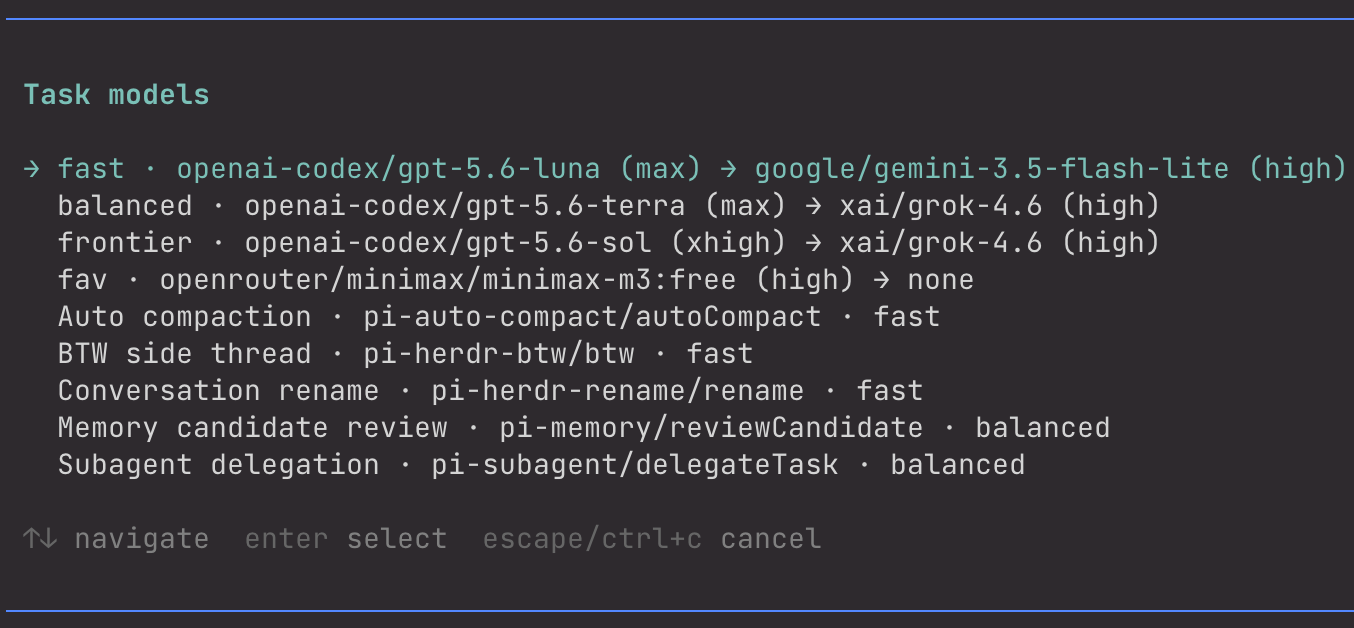
Configure shared Task Routes for the Task Profiles fast, balanced, frontier, and fav. A Task Route is one model and one thinking level. You configure the routes one time, and each extension keeps ownership of its Model Task and default.

Install
This package requires Pi 1.1.0 or later in the 1.x series. Upgrade Pi before you install version 8.1 or later of this package.
pi install npm:@henryqw/pi-task-modelsRun /task-models after installation. Configure each profile that your installed consumers require.
Works with
| Package | Relationship | Purpose |
|---|---|---|
@henryqw/pi-auto-compact |
Consumer | Its local compaction task defaults to fast. |
@henryqw/pi-herdr-tools |
Consumer | Its side-thread and rename tasks default to fast. |
@henryqw/pi-memory |
Consumer | Its local candidate-review task defaults to balanced. |
@henryqw/pi-multi-codex |
Improves | Numbered Codex slots become one route. |
@henryqw/pi-prompt-creator |
Consumer | Its local prompt-drafting task defaults to fast. |
@henryqw/pi-subagent |
Consumer | Its local delegation task defaults to fast. Callers can declare their own task. |
Use
Run /task-models to complete the first setup:
- Select
fast. - Choose a primary model from Pi’s effective registry. Then choose its thinking level.
- Choose a different fallback model and thinking level, or choose
None. - Reopen
/task-models. Thefastrow now shows the saved route instead ofnot configured.
| Surface | Type | Purpose |
|---|---|---|
/task-models |
command | For people: configure shared profile routes and assign profiles to active consumer tasks. |
/task-models preset |
command | For people: choose a saved setup for any of fast, balanced, frontier, and fav. |
Option+S / Alt+S in /task-models |
shortcut | For people: save the current profile setup as a named preset in the interactive terminal. |
| Session start | ui | For people: when the shared config is missing, show a warning that points to /task-models. |
Repeat these steps for balanced, frontier, or fav when a consumer needs them. The fav profile has no fallback.
Select an active task to override its declared profile. If you choose the declared default of that task, /task-models removes the override.
Flow
Consumers register declarations at extension load. When /task-models opens, the shared control plane asks active extensions for declarations. Extension load order does not matter.
The control plane lists each active task’s effective profile. When you disable a consumer, the control plane hides its explicit assignments but keeps them stored.
Menus and route resolution use ctx.scopedModels of the current session, including pinned thinking. An empty scope uses available text models from Pi’s registry. The control plane removes duplicate numbered Codex account aliases.
Fallback choices exclude the selected primary. BTW selects the first authenticated viable route before it starts the pane.
Config
The shared JSON file is at ~/.pi/agent/config/pi-task-models/config.json. Only explicit /task-models actions save it.
The following JSON shows structure only. Every model ID is a placeholder. Do not copy it.
{
  "profiles": {
    "fast": {
      "primary": { "model": "<provider>/<fast-model-from-Pi>", "thinkingLevel": "low" },
      "fallback": { "model": "<provider>/<fallback-model-from-Pi>", "thinkingLevel": "low" }
    },
    "balanced": {
      "primary": { "model": "<provider>/<balanced-model-from-Pi>", "thinkingLevel": "high" }
    },
    "frontier": {
      "primary": { "model": "<provider>/<frontier-model-from-Pi>", "thinkingLevel": "max" }
    },
    "fav": {
      "primary": { "model": "<provider>/<favorite-model-from-Pi>", "thinkingLevel": "high" }
    }
  },
  "tasks": {
    "pi-herdr-btw/btw": "balanced"
  }
}
Use exact model IDs offered by /task-models. Pi’s registry, not this example, defines available models.
| Name | Description | Values | Default |
|---|---|---|---|
profiles |
Stores configured shared routes by profile name. | Object keyed by fast, balanced, frontier, or fav. Task Models rejects unknown profile names. |
{} (no profiles configured) |
profiles.<profile>.primary.model |
Selects the primary model. Required within a configured primary route. |
Canonical provider/model reference without whitespace or NUL; available models come from Pi’s model registry or session-scoped models. |
— |
profiles.<profile>.primary.thinkingLevel |
Sets the primary model’s thinking level. Required within a configured primary route. |
off, minimal, low, medium, high, xhigh, or max; the model must support the level when the route resolves. |
— |
profiles.<profile>.fallback |
Sets the route to try when the primary route is unavailable. | Object requiring model and thinkingLevel under the same rules as primary; not allowed for fav. |
No fallback route. |
tasks |
Stores explicit profile overrides by task ID. | Object mapping task IDs (<package>/<task>) to profiles. |
{} |
tasks.<taskId> |
Overrides that task’s declared profile. | fast, balanced, frontier, or fav. |
That task declaration’s defaultProfile |
Pi’s model registry, including session-scoped models, is the source of available models. This file does not contain a model catalog.
Task defaults are only in consumer declarations. Existing explicit assignments, including one equal to a declaration’s default, remain valid.
Model references use canonical provider/model. Pi’s registry resolves numbered Codex account aliases (openai-codex-N). Task Models stores them canonically as openai-codex/<model>.
Presets
To apply a saved setup, run /task-models preset. Then choose a name from the list. All four profiles (fast, balanced, frontier, and fav) are optional. An omitted profile keeps its current values. Each included profile replaces its complete routes, including thinking levels and optional fallbacks, in one atomic config update. Task assignments stay unchanged. If you cancel the picker, Task Models writes nothing.
To create a preset, open /task-models. In the main menu, press Option+S (macOS) or Alt+S. Then enter a name. The preset contains all configured profiles with their thinking levels and fallbacks. It does not contain task assignments. You must configure at least one profile. If you use an existing name, Task Models asks for confirmation before it replaces that preset. Other presets stay unchanged. If you cancel either prompt, Task Models writes nothing.
The shortcut requires interactive terminal mode. The terminal must send Option/Alt as Meta (Escape). RPC does not support this shortcut. You can also edit ~/.pi/agent/config/pi-task-models/presets.json manually. The file maps preset names to any subset of the four profiles. It uses the same route format as the active config:
{
  "my-setup": {
    "fast": {
      "primary": { "model": "<provider>/<fast-model>", "thinkingLevel": "low" }
    },
    "balanced": {
      "primary": { "model": "<provider>/<balanced-model>", "thinkingLevel": "high" },
      "fallback": { "model": "<provider>/<fallback-model>", "thinkingLevel": "medium" }
    }
  },
  "favorite-only": {
    "fav": {
      "primary": { "model": "<provider>/<favorite-model>", "thinkingLevel": "high" }
    }
  }
}
Replace every placeholder with an exact reference from /task-models. Add more named objects for more setups. For an included profile, omit fallback if you want no fallback. fav never accepts a fallback. To keep the existing routes of a profile, omit the full profile. Preset names must not be empty, must not start or end with whitespace, and must not contain control characters. The picker shows names in alphabetical order.
A missing, empty, or invalid preset file does not change the active config. The file must be valid UTF-8 JSON and 64 KiB or smaller. If one preset is invalid, the picker does not open. Task Models reports read and save failures. It does not overwrite malformed files. A save creates the preset file if it is missing. The save uses a private atomic write under a lock. Task Models asks for confirmation before it takes the lock, so an open prompt does not block other sessions. A save waits a short time for the lock of another session. If another session saves the same new name first, Task Models reports the conflict and writes nothing. Try again. When you apply a preset, Task Models can create a missing active config. It cannot overwrite an invalid active config. A preset switch stores routes and does not check current authentication, model availability, or thinking support. When a task runs, the usual scope and route-resolution rules apply.
API
| Surface | Type | Purpose |
|---|---|---|
PROFILE_NAMES |
constant | Lists the shared profiles: fast, balanced, frontier, and fav. |
THINKING_LEVELS |
constant | Lists supported thinking level names. |
ProfileName |
type | Names one shared profile. |
ThinkingLevel |
type | Names one thinking level. |
ModelTask |
type | Describes a consumer-owned independently executed model operation. |
TaskModelRoute |
type | Stores a model reference and thinking level. |
TaskModelProfile |
type | Stores a primary route and optional fallback. |
TaskModelsConfig |
type | Stores profile routes and explicit task assignments. |
AvailableModel |
type | Represents a model from Pi’s registry. |
ResolvedTaskRoute |
type | Represents a model and thinking level resolved for the current session. |
TaskRouteErrorCode |
type | Identifies a route-resolution failure. |
TaskRouteError |
type | Carries a route error code and optional profile name. |
registerModelTask(pi, task) |
function | Registers a consumer’s task declaration at extension load. |
loadTaskModelsConfig(agentDir?) |
function | Reads and validates the owner config file when present. |
canonicalModelReference(model) |
function | Validates and canonicalizes provider/model, including numbered Codex aliases. |
modelReference(model) |
function | Formats a model as provider/model. |
dedupeAvailableModels(models, preferredProvider?) |
function | Removes duplicate canonical model references. Prefers a provider when requested. |
resolveAvailableModel(models, reference, preferredProvider?) |
function | Finds a model by reference, including numbered Codex aliases. |
availableTaskModels(ctx) |
function | Lists usable text models from the current session scope or, when empty, Pi’s registry. |
taskThinkingLevels(ctx, model) |
function | Lists supported thinking levels and applies any session-pinned level. |
resolveTaskModelRoute(ctx, route, thinking?) |
function | Resolves one route against the current session, if available. |
resolveConfiguredTaskRoute(ctx, task, agentDir?, thinking?) |
function | Resolves the first usable route for a task. |
resolveConfiguredTaskRoutes(ctx, task, agentDir?, thinking?) |
function | Resolves the task’s configured route candidates. |
executeTaskRoutes(routes, attempt, { shouldFallback, signal? }) |
function | Tries supplied resolved routes in order and returns the first success. |
orderedProfileRoutes(profile) |
function | Returns the primary route followed by the optional fallback. |
createTaskModelsExtension(pi, options?) (also the default export) |
function | Registers the /task-models command and missing-config warning. |
Model and route helpers use only ctx.model, ctx.scopedModels, and ctx.modelRegistry.getAvailable(). They do not require UI methods, so consumers can use different supported Pi 1.x versions.
Consumers do not access the config file directly. loadTaskModelsConfig() returns source as "file" or "missing", so consumers can warn when defaults are in use.
Profile thinking is authoritative. Resolution uses config.tasks[task.id] ?? task.defaultProfile.
Consumers never read or write the shared file directly.
Limits and recovery
loadTaskModelsConfig() returns { source: "missing", value: { "profiles": {}, "tasks": {} } } for a missing file. It does not create a file.
At session start, Task Models warns when the shared config is missing. Run /task-models to configure task routes.
Malformed JSON, unknown keys, invalid task IDs, unknown profiles, or invalid profile or route values cause the config load to fail. Task Models keeps the file. Repair or restore the file before you open /task-models again. /task-models cannot load or overwrite an invalid config.
Resolution errors are TaskRouteError values. Check taskRouteCode:
| Code | Meaning |
|---|---|
config-missing |
The optional shared config file is absent. |
config-read |
Task Models cannot read or validate the existing shared config file. Repair its contents or permissions before you use /task-models. |
profile-missing |
The selected profile is not configured. Set it in /task-models. |
no-route |
The selected profile has no available route. Choose an available model and thinking level in /task-models. |
For config-missing, run /task-models to create the file. A consumer may silence only config-missing when it has a safe current-session fallback.
executeTaskRoutes() uses only caller-supplied resolved routes. It does not resolve routes, authenticate, inspect providers, log, wait, or retry a route.
It rejects empty route lists and checks its optional abort signal before every attempt. It stops on cancellation or when shouldFallback(error) returns false.
After allowed failures, it rethrows the final route error unchanged. Each attempt must be atomic and safe to repeat.